
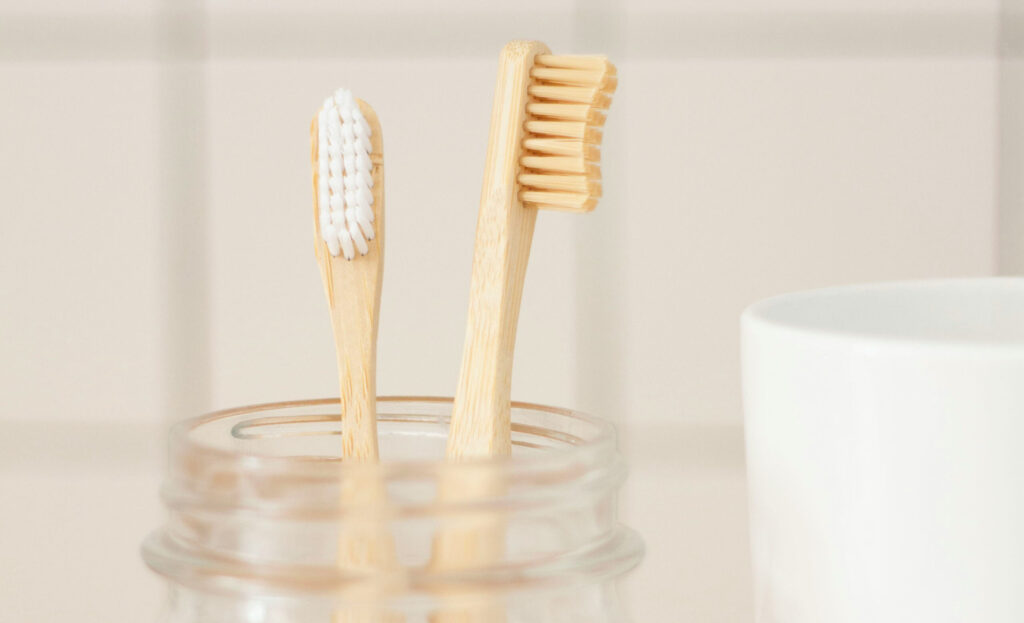

I went looking for a plastic-free toothbrush expecting a quick swap. Three days and a few rabbit holes later, here’s what netted out. My goals were simple: less waste, and less microplastic exposure from what’s actually touching my teeth. It took more digging than expected to get past the marketing, but almost nothing solves both goals at once, and a “plastic-free” label usually addresses one of those problems, not the other. Here’s how the options actually compare.
Table of Contents
Two separate problems: bristles and handle
Most eco-friendly toothbrushes focus on the handle. The bristles are a separate material decision, and it’s worth understanding both.
Bristles: 3 categories
So what types of bristles are actually out there? There are three main categories.
Nylon (including castor oil nylon)
This is the standard, and for good reason: it cleans well, it’s what dentists generally recommend, and it’s the material behind most ADA-accepted toothbrushes. Castor oil nylon (nylon-11 or nylon-1010) is the plant-based version, swapping out petroleum as the feedstock, a genuine improvement in where the material comes from. What it doesn’t change is what happens at disposal: both versions are still synthetic polymers once processed, so neither composts at home or breaks down in soil or ocean, and it’s a detail most “natural” toothbrush brands aren’t upfront about.
What’s actually biodegradable? Boar and horsehair
Both truly biodegrade, unlike castor oil bristles, but neither is vegan or certifiable cruelty-free.
What about other materials? Silicone
Silicone is already used as a plastic replacement in children’s food ware and is medical grade, so on paper it should solve the shedding problem entirely. It doesn’t quite. It’s not as effective at cleaning on its own, and the leading maker, FOREO, still pairs it with PBT polymer bristles rather than going all-silicone. It’s not biodegradable either, silicone can take up to 500 years to break down.
The outcome
Nylon, specifically castor oil nylon, is my pick. Even though it’s a bioplastic (a synthetic polymer), it’s still the best option on the market: it cleans reliably, and it’s what dental research and recommendations are built around. There isn’t a cruelty-free option that solves biodegradability too, at least not yet, so one way to address microplastic concerns in the meantime is sticking to the 3 to 4 month bristle replacement window. Frayed bristles shed more, so staying on schedule does real work here.
Handle: what happens when it wears out
Dentists recommend replacing bristles every 3 to 4 months. So the handle question is really about waste over time: what happens to the rest of the toothbrush on that same schedule.
Disposable, snap-off head: Bamboo handle with a scored point, snap off the head, compost the handle, bin the head. Brush with Bamboo does this. You’re still useing a new toothbrush each cycle.
Reusable handle, replaceable head: One handle, only the head swaps out. Actually cuts waste instead of just changing its shape. Etee and Better & Better do this in bamboo; Hello in aluminum. Worth keeping in mind why this matters at scale: an estimated 1 billion toothbrushes are thrown away in the US alone every year, around 50 million pounds of plastic waste, much of it handles that didn’t need replacing along with the bristles.
Where I’ve landed
Every option gives something up: biodegradability, vegan, verified sourcing, or cleaning power, and oral health remains a priority.
So where does that leave us? My choice is etee: vegan, with a detachable bristle head that swaps out instead of replacing the whole toothbrush, cutting the waste of tossing a full handle every cycle. It uses bamboo, which is biodegradable, for the parts it can actually solve. Once the bristles are removed, the head itself composts. etee is also upfront that the bristles aren’t biodegradable yet and lays out exactly how to dispose of them properly. Better & Better is a solid option to review.
FAQ
Is a bamboo toothbrush fully biodegradable?
The handle is, if it’s real bamboo. The bristles aren’t: most “plant-based” bristles are castor-oil nylon and have to be removed before the handle composts.
Are castor oil bristles biodegradable?
No. Castor oil replaces petroleum as the feedstock, which cuts down on fossil fuel use, but the resin (nylon-11 or nylon-1010) is still a synthetic polymer once processed. It won’t compost at home or break down in soil or ocean any differently than regular nylon.
Do silicone toothbrushes clean as well as nylon?
Mixed evidence. Most silicone toothbrushes, including FOREO’s ISSA line, are hybrids with PBT polymer, not all-silicone.
Does a reusable handle actually reduce waste?
Yes. You still replace the head every 3 months either way, but you’re not also making and tossing a full new handle each cycle. That adds up: an estimated 1 billion toothbrushes are thrown away in the US alone every year, around 50 million pounds of plastic waste, much of it handles that didn’t need replacing along with the bristles.